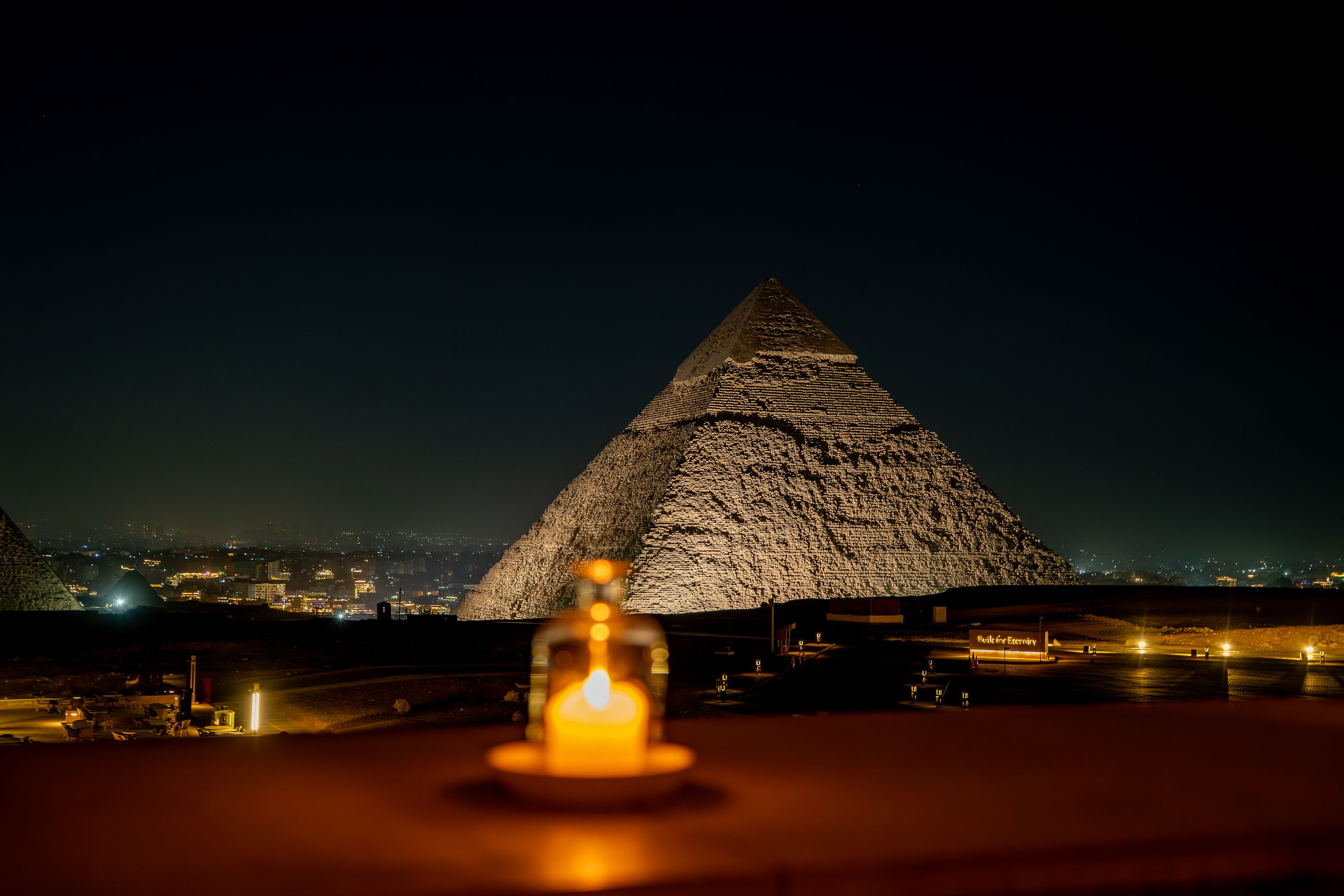
To witness the Giza Plateau at noon in midsummer is to endure an assault on human endurance. In the blistering 43°C (110°F) desert glare, the ancient necropolis is transformed into an exhausting friction zone: exhaust fumes from idling diesel tour coaches choke the horizon, unregulated camel drivers aggressively corral bewildered travelers, and blinding heat radiates off four-thousand-year-old limestone blocks. But as dusk settles over Greater Cairo, a radical transformation takes place. Driven by a state-backed imperative to quadruple tourism revenues and escape the crippling thermal realities of North African summers, Egypt’s Ministry of Tourism and Antiquities (MoTA)—in partnership with private conglomerates—has initiated a high-stakes modernization drive: "The Pyramids After Dark." Behind heavily armed military cordons, modern electric shuttles glide across freshly paved panoramic tarmac, high-output architectural projection arrays slice through the desert gloom, and private after-hours permits unlock the inner chambers of Khufu in total, eerie silence. Our editorial team went behind the security lines to audit the operational mechanics of this new nocturnal frontier.
Access Window
18:00 – 22:30 (Special Clearance Only)
Thermal Drop
42°C Midday down to 23°C Nocturnal
Permit Protocol
MoTA Supreme Council Special Sanction
Transit Vector
Orascom Electric Shuttle Network
"Beneath the architectural projection beams, the four-thousand-year-old limestone loses its bleached daytime postcard sheen. In the cool stillness of the desert night, the Great Pyramid reclaims its original, formidable posture: an imposing, near-extraterrestrial titan staring down the neon sprawl of 22 million Cairenes."
For decades, the daylight experience at Giza was defined by logistical exhaustion. Visitors were funnelled through congested, chaotic turnstiles at the foot of the Great Pyramid or near the Sphinx entrance, instantly engulfed by a relentless gauntlet of unlicensed "guides," horse-drawn carriage drivers, and alabaster statuette hawkers operating out of the adjacent village of Nazlet El-Semman. Combined with zero atmospheric shade and soaring Saharan heat indices, the experience left many travelers overwhelmed.

The After-Hours Metamorphosis: When the daytime gates slam shut at 5:00 PM, the tour buses clear out, the tout unions disperse to the tea houses outside the boundary wall, and an astonishing silence falls over the plateau. The ambient temperature drops rapidly by up to 18 degrees Celsius.
What replaces the chaos is a clinical, tightly controlled corporate ecosystem. The Egyptian billionaire Naguib Sawiris's firm, Orascom Pyramids Entertainment (OPE), has poured tens of millions of dollars into developing new visitor reception centers, asphalt access circuits, and elevated fine-dining terraces like the 9 Pyramids Lounge. At night, the plateau is transformed from an open-air chaotic souk into an exclusive, curated stage for high-net-worth travelers, international dignitaries, and luxury tour delegations.
Operating within the Giza Plateau at midnight is not a casual stroll; it is a logistically intricate maneuver monitored by Egypt's highest security echelons. The plateau sits directly adjacent to military staging sectors and the sensitive desert transit routes heading west toward the Libyan border.
The Three-Tier Security Sieve: Penetrating the after-hours sector requires clearing three distinct inspection rings:
1. The Outer Checkpoint: Armored personnel carriers of the Central Security Forces (CSF) and police checkpoints scrutinizing private vehicle credentials along Al-Haram Street and the Desert Road approach.
2. The Antiquities Police Gate: Passport and barcode scans against pre-cleared passenger manifests submitted to the Ministry of Interior 48 hours in advance.
3. The Desert Perimeter: Mobile patrols mounted on four-wheel-drive pickups equipped with thermal night-vision optics, ensuring no unauthorized pedestrians slip over the low boundary walls from the southern desert or the cemetery corridors.
Inside this perimeter, you are safer than anywhere else in Greater Cairo. The atmosphere is stark, quiet, and guarded with absolute military precision.
Night access at Giza is aggressively stratified by financial resources. The experience ranges from a commercial laser show to complete, solitary mastery of the plateau. Here is our exclusive investigative breakdown of the real-world costs:
Sound & Light Spectacle
Hover or Tap for Details 🔄
The Commercial Tier
Confined to the open-air bleachers facing the Sphinx; no free wandering
Aging 1960s theatrical narration; currently undergoing modernized laser upgrades
Nocturnal Plateau Dining
Hover or Tap for Details 🔄
The Lounge Circuit
Guaranteed plateau gate pass after 6:00 PM via bookings at 9 Pyramids Lounge
Mezze, grilled meats, and shisha overlooking illuminated pyramids in cool desert air
Private MoTA Solitary Entry
Hover or Tap for Details 🔄
The Sovereign Tier
Exclusive opening of the Great Pyramid of Khufu or the Paws of the Sphinx
Zero public tourists; private Egyptologist; standing entirely alone in the King's Chamber
Field Warning: Never hand cash to informal touts outside the gate claiming they can "sneak you onto the plateau through the cemetery" after hours. Egyptian Antiquities Police enforce strict criminal trespassing laws within the archeological perimeter, which can result in detention, heavy fines, and immediate deportation.
To reach Giza at night, you must navigate the concrete circulatory system of Africa's largest metropolis. Cairo at 9:00 PM is not winding down; it is hitting peak kinetic velocity.

The Highway Modernization: The recent construction of massive, multi-lane flyovers and the widening of the Ring Road (El-Daery) has radically shortened travel times from upscale downtown districts like Zamalek and Garden City down to 35-45 minutes. Furthermore, the newly opened Sphinx International Airport (SPX), located just 20 minutes west of the plateau, now allows private charters and seasonal low-cost European carriers to land passengers directly adjacent to the monuments without ever entering central Cairo traffic.
The Electric Buggy Protocol: Upon reaching the newly constructed Giza North entrance terminal near the Grand Egyptian Museum (GEM), all private commercial combustion vehicles are halted. Visitors transition into quiet, state-operated electric shuttles that hum silently through the pitch-black desert roads between the monuments.
Cairo’s culinary pulse only reaches its true stride long after midnight. While the international hotel chains lining the Giza Pyramids Road push predictable continental buffets, authentic nocturnal exploration demands diving into the city’s unpretentious street institutions.

Koshary Abou Tarek at 01:00 AM: Located downtown, this multi-story temple to Egypt's national dish serves mountains of rice, lentils, macaroni, and chickpeas drowned in spicy tomato sauce, garlic vinegar (da'ah), and crispy fried onions for less than $3 USD. At 1:00 AM, the dining rooms are electric with families, night owls, and Cairene taxi drivers refueling between shifts.
Hamam Mahshi (Stuffed Pigeon) in Nazlet: For a meal within visual sight of the illuminated monuments, seek out the traditional grill houses bordering the eastern wall of Nazlet El-Semman. Stuffed with seasoned cracked green wheat (freek), liver bits, and cumin, then roasted over glowing hardwood coals, it represents the heart of traditional Egyptian hospitality.
Visiting Egypt in the warmer months without suffering heat exhaustion requires an inverted circadian strategy: sleep through the midday desert inferno, and execute all strategic movements between dusk and dawn.
Day 1: The Nocturnal Bastion & Sphinx Reconnaissance
• 05:00 PM: Wake and check in to the historic Mena House or a ridge-side boutique hotel in Giza.
• 07:00 PM: Enter the plateau via pre-booked electric shuttle passes for dinner at 9 Pyramids Lounge. Experience the dramatic sunset transitions as the three pyramids are struck by amber illumination.
• 10:30 PM: Coffee and shisha on a rooftop overlooking the illuminated paws of the Great Sphinx as the surrounding city hushes.
Day 2: Grand Egyptian Museum (GEM) & Old Cairo Night Alleys
• 06:00 PM: Take an evening tour of the Grand Egyptian Museum’s towering glass atrium, dominated by the colossal 3,200-year-old statue of Ramesses II.
• 09:30 PM: Head into the medieval heart of Islamic Cairo. Walk down Al-Muizz li-Din Allah Street, the world’s dense concentration of medieval Islamic architecture, glowing under gentle golden spotlights.
• Midnight: Strong black mint tea at the historic El-Fishawy Cafe in the labyrinthine Khan el-Khalili bazaar, open continuously since 1773.
Day 3: The Holy Grail: Private Khufu Interior Clearance
• 07:00 PM: Private armed escort from your hotel directly through the security gates of the plateau.
• 08:00 PM: Enter the Great Pyramid of Khufu entirely alone. Climb the claustrophobic 47-meter-long, 8-meter-high Grand Gallery without another human soul in sight.
• 09:00 PM: Stand inside the red-granite King's Chamber in utter, heavy silence—an experience completely impossible during crowded daytime hours.
Behind the gleaming PR videos of silent electric buggies and luxury VIP dining lies a fierce socio-economic struggle for the economic soul of the Giza Plateau.
⚠️ Socio-Economic Notice: The Animal Cart Ban
For over a century, the families of Nazlet El-Semman enjoyed a virtual monopoly over horse and camel transport across the plateau, often operating with deeply criticized animal welfare standards. The state-backed Orascom master plan has systematically pushed these traditional operators to the outer boundaries, replacing them with a corporatized electric transit grid. The displacement has sparked friction: nighttime visitors walking outside the security perimeter should expect intensely persistent touting from displaced operators desperate to capture tourists diverted from the daytime trade.
The Ethics of Tipping (Baksheesh): The modernization of the plateau has shifted revenue streams into corporate and state hands, often squeezing low-wage site attendants, cleaning staff, and junior Antiquities Police. A discrete tip of 50 to 100 EGP ($1 to $2 USD) to night guards opening gates or holding flashlights along ancient stone stairways is universally appreciated and maintains local goodwill.
Photography Protocols: Heavy commercial tripods, gimbal rigs, and lighting panels are strictly scrutinized at night checkpoints. The Ministry of Tourism permits standard handheld mirrorless/DSLR cameras and mobile phones for personal use, but deploying professional light fixtures without an advance $1,000/day commercial film permit will lead to immediate confiscation by police.
Field Intelligence FAQ
No. General pedestrian access to the Giza Plateau closes strictly at 4:00 PM in winter and 5:00 PM in summer. Nocturnal access is restricted exclusively to ticket holders of the official Sound and Light show, patrons of authorized panoramic restaurants like 9 Pyramids Lounge, or visitors holding expensive, pre-arranged private after-hours permits issued directly by the Supreme Council of Antiquities.
Securing private, solitary access inside the Great Pyramid of Khufu outside standard operating hours costs approximately $1,500 to $2,500 USD (charged in Egyptian Pound equivalent) for a designated two-hour window for small private delegations, managed through licensed diplomatic or luxury operators approved by the Ministry of Tourism and Antiquities.
The plateau interior is under heavy armed surveillance by Egypt's Tourism and Antiquities Police, backed by Egyptian Armed Forces perimeter cordons. It is exceptionally safe inside the official security gates. However, the outer perimeter village of Nazlet El-Semman requires situational vigilance due to aggressive informal taxi touts, camel handlers, and souvenir hustlers operating in low-light corridors.
Between May and October, daytime temperatures on the unshaded limestone plateau regularly exceed 42°C (108°F), creating severe heat stress. At night, desert thermal radiation causes temperatures to plunge to 22°C–26°C with refreshing northern breezes, eliminating thermal exhaustion and allowing comfortable, extended exploration.
As part of the Giza Plateau Master Plan executed by Orascom Pyramids Entertainment (OPE), unauthorized private vehicles, tourist coaches, and unregulated animal carts are being systematically banned from the inner archeological zone. Visitors must board dedicated zero-emission electric shuttles running between modern visitor centers and designated panoramic viewpoints.
Unlock Exclusive Giza After-Hours Clearances 🏺
Bypass the scorching desert sun and daytime crowds. Secure authorized VIP plateau passes, private Great Pyramid clearances, and licensed executive transfers.
Audit Private Night Clearances